
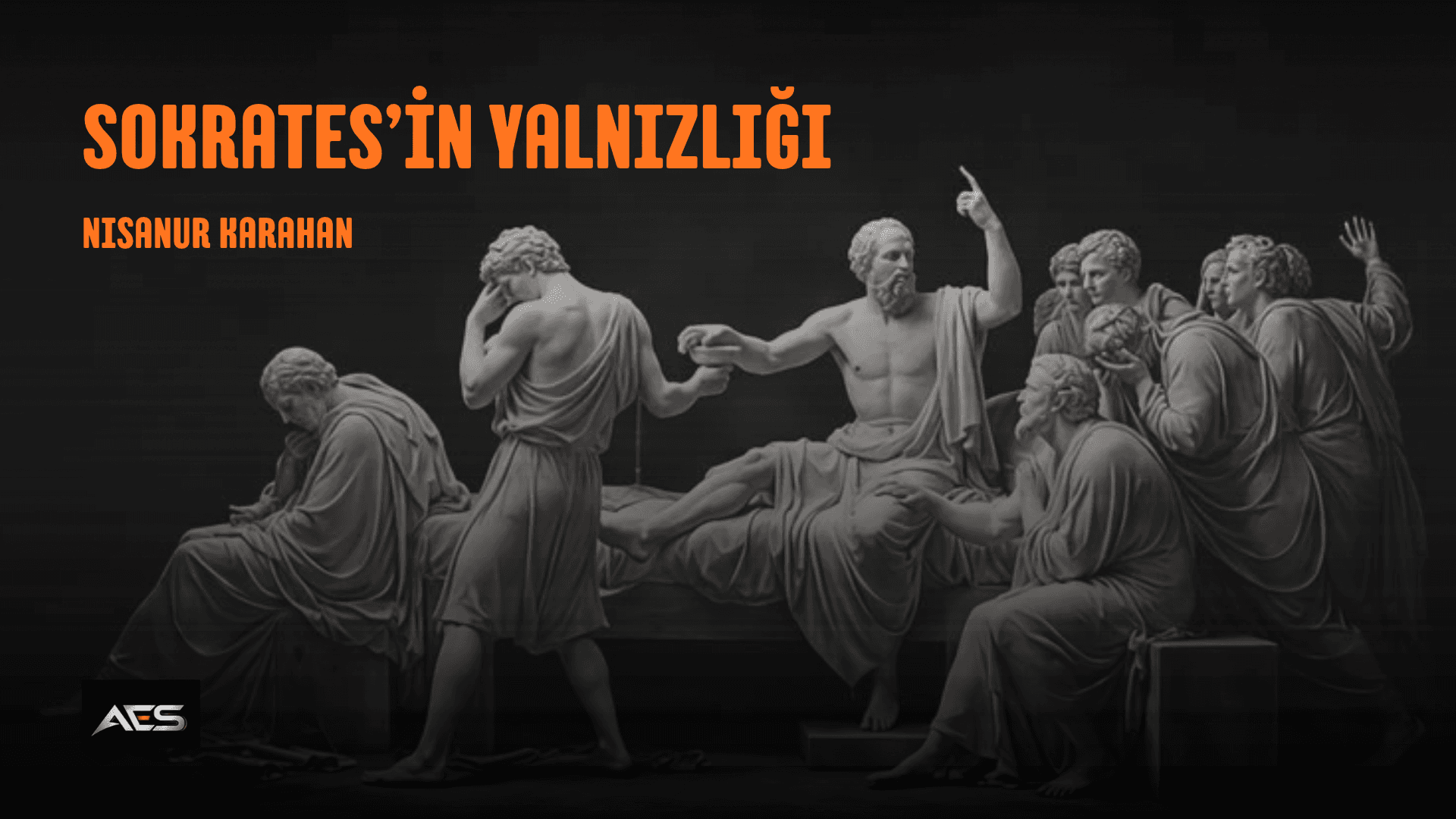
Socrates's Loneliness
Nisanur Karahan·October 5, 2026
Throughout his life as a philosopher, Socrates made his voice heard, engaged in debate, and mentored many philosophers by passing on his knowledge. Although few contemporary sources exist, we know of him primarily through Plato—specifically via The Apology of Socrates and Plato’s own accounts. He gathered people around him and never hesitated to voice his ideas. Even as he faced death, he remained fully aware of the profound significance of his mission. Despite the pleas of those around him to "give it up" or "back down," he refused to do so. He met his end after delivering the famous defense speech that is still discussed today; he stood firm against evil and injustice, even at the cost of his life. While addressing the court that accused him—acknowledging that he "ran slowly" and noting how quickly evil can spread—he was, in effect, already embracing death. For him, death was nothing to fear. He argued that we should fear what we know, not what is unknown; since we do not know death, there is no reason to fear it. He stood his ground resolutely, without compromising his philosophy, in the face of accusations that he was corrupting the youth and disbelieving in the gods. What does this stance and defense reveal to us?
This is not merely the execution of a single man; it is a testament to freedom.
It demonstrates that ideas and philosophy do not die. This is due to Socrates, who defended himself steadfastly until the very end. It illustrates how even the act of self-sacrifice for a cause can trigger a monumental chain of events for the future. Had he chosen the opposite path, survival would have brought him only inner turmoil. Through his death, he also seeks to demonstrate just how far the wicked are capable of going. The determination he displayed and his conduct before the court serve as an inspiring symbol. He reminds us directly of what an invaluable gift this is and urges us to hold fast to the truths we know. This constitutes the ultimate human freedom.
These truths may be things we have personally experienced or lived through; they may be spiritual or material truths. Everyone has their own reality or truths that are visible to the eye. This is why philosophy is so valuable: it prompts us to question and compels us to think. It generates arguments and fosters debate. We do not simply accept the truths of others; instead, we question those truths. Socrates, who articulated his philosophy and defended himself before the great Athenian court, encourages us to question the very court that handed down that verdict.
So, is the court open to scrutiny? Why do we feel the need for this?
Did other philosophers emerge after Socrates’ defense and execution? Yes. Many thinkers who championed their ideas in an environment of freedom have appeared throughout history. No one retreated in the wake of Socrates’ death; they did not shy away from their ideas or their stance. Faith, religion, and morality have always been subjects of reflection, criticism, and inquiry. Philosophy, humor, and satire are present in every sphere concerning humanity. Societal issues remain the central theme of every era. Situations arise where wrongdoers go unpunished, trust in the courts erodes, religion is exploited, and ignorance takes tangible form. There are individuals who speak out against this, convey it to society through art, turn it into a subject of humor, and dedicate their lives to revealing the truth. At times and in certain circumstances, we witness these people being punished with death or imprisonment. Another crucial point is how society perceives this and from which perspective it views the matter. In communication, a message sent to a receiver may return interpreted in a different way; a factor known as "noise" intervenes as the message travels to the receiver. When considering this "noise" today, we can point to the way information—or mere fragments of it—is framed in the media. News reports and commentaries regarding a situation or event might reflect a reality contrary to the actual truth if they present only a specific segment rather than the whole picture. How was the court—which dismissed Socrates’ ideas by labeling him "godless" and accusing him of denying God—viewed in the eyes of the public? Let us compare this with the perspective of Socrates’ students and those who conversed with him. How did his students view the situation? What was the aim of those around him who disparaged and maligned him? Or, what did the court prove by causing Socrates’ death? There are many such questions we could ask; they warrant deep reflection. For we will still be talking about these things—and about Socrates—even as years go by. In this scenario, it is the titles and names that will change.